







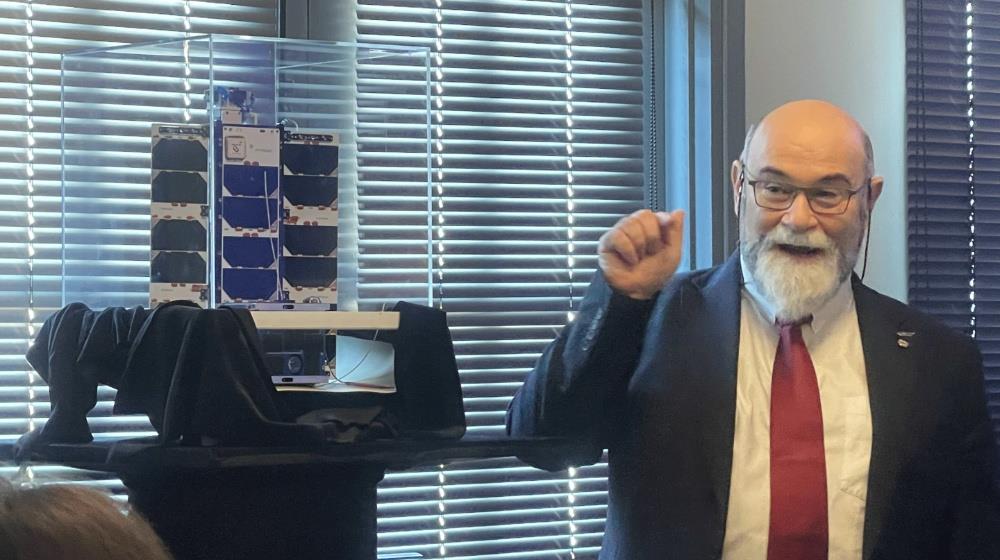
The first three satellites manufactured in Cyprus, named 'Kyrenia 3', were unveiled during a press conference held by the Cyprus Space Exploration Organisation (CSEO), under the auspices of Chief Scientist for Research, Innovation and Technology Demetris Skourides.
The satellites will be able to monitor forest fires, detect them early and track their development, explained CSEO President George Danos (pictured above). They will also be used to monitor crops, water resources, broken pipes and leaks, which are particularly important at present, as well as to monitor Cyprus’ seas and provide maritime surveillance.
During the 16 November unveiling, Danos said that the organisation had promised to present one satellite, “but you can see two, and there is another one in the laboratory. So, we have gone beyond our promise of one and now have three satellites.”
According to the CSEO President, the microsatellites are being manufactured in a clean room that meets ISO 7 standards.
Danos also explained the reasoning behind the name 'Kyrenia 3'.
“We say today that our ancestors began long ago with ‘Kyrenia’, (the Kyrenia Ship is a 4th-century BC ancient Greek merchant ship that sank near the town of Kerynia in 1967, which is under Turkish occupation since 1974) then we moved to ‘Kyrenia 2’ (a replica of the ancient ship), and today we are moving to ‘Kyrenia 3’. This is the official name of the series of microsatellites that we will manufacture here,” he said.
In his address, Chief Scientist Demetris Skourides said that the unveiling of 'Kyrenia 3' carried particular symbolism, as it “connects Cyprus’ history with a new chapter of exploration and scientific creation. From the ancient seas to the skies.”
Most importantly, according to Skourides, “Cyprus is no longer simply observing this journey. It is participating, creating and shaping its own future. A future in which our children will be able to look at the sky and know that they can reach much further than they might have imagined.”
Referring to the Cyprus Space Research and Innovation Centre (C-SpaRC), Skourides described it as “an integrated strategic infrastructure covering a broad range of activities, from satellite design and manufacturing to the testing, certification and operation of space systems.”
He said that a space microlaboratory had been established in Nicosia, equipped with specialised facilities for the microfabrication and testing of microsatellites. At the same time, C-SpaRC has developed capabilities in space mission control, space weather monitoring and space health research.
“Most importantly, these capabilities are not intended solely for research teams. They will also be available to universities, research institutions, start-ups and companies within Cyprus’ space ecosystem. This means that Cyprus is now acquiring expertise and infrastructure that, until today, required access to specialised centres abroad, but which are now available here, open to everyone,” Skourides added.
Through the Schools for Space programme, according to Skourides, students from cities across Cyprus will have the opportunity to participate by “building their own indicators and communicating with satellites.” They will also be able “to send messages from Cyprus into space,” he said.
Skourides noted that there were multiple benefits for scientists and engineers, as “C-SpaRC creates opportunities for young researchers, attracts internationally recognised scientists and contributes to the creation of highly specialised jobs.”
He added that the Cyprus Space Cluster now comprises more than 60 businesses and organisations, while its status as a Cypriot association and member of the European Space Agency creates new opportunities for international cooperation and business development.
The Chief Scientist also officially inaugurated the Space Weather Control Centre.
Through an application, interested users can monitor and receive information and forecasts about space weather.
“We can see the Sun and identify which regions may experience a phenomenon at any given moment. All these phenomena that affect GPS and aviation are covered by our own forecasts at a higher level,” Danos said.
In his address, the Metropolitan of Kyrenia, Chrysostomos, described the initiative as a significant and historic scientific undertaking.
“It was destined that, in our time, a trilogy would be completed, involving a craft that once again brings knowledge, science, expertise and information. Only this time, it will not unfurl sails on the seas like a ship, nor wings in the skies like an aircraft, but solar panels in space, demonstrating the capabilities of the mission, advancing information gathering and conducting experiments, while always bearing the same name. The name Kyrenia, with all the meanings and symbolism it carries,” he said.
(Source: CNA)